Start from English
Describe a rule in English, French, German, or Spanish. AI proposes a formula, a glossary, and open questions, with concrete alternatives when the wording is ambiguous. Nothing is accepted until you confirm it.
Make logic tangible
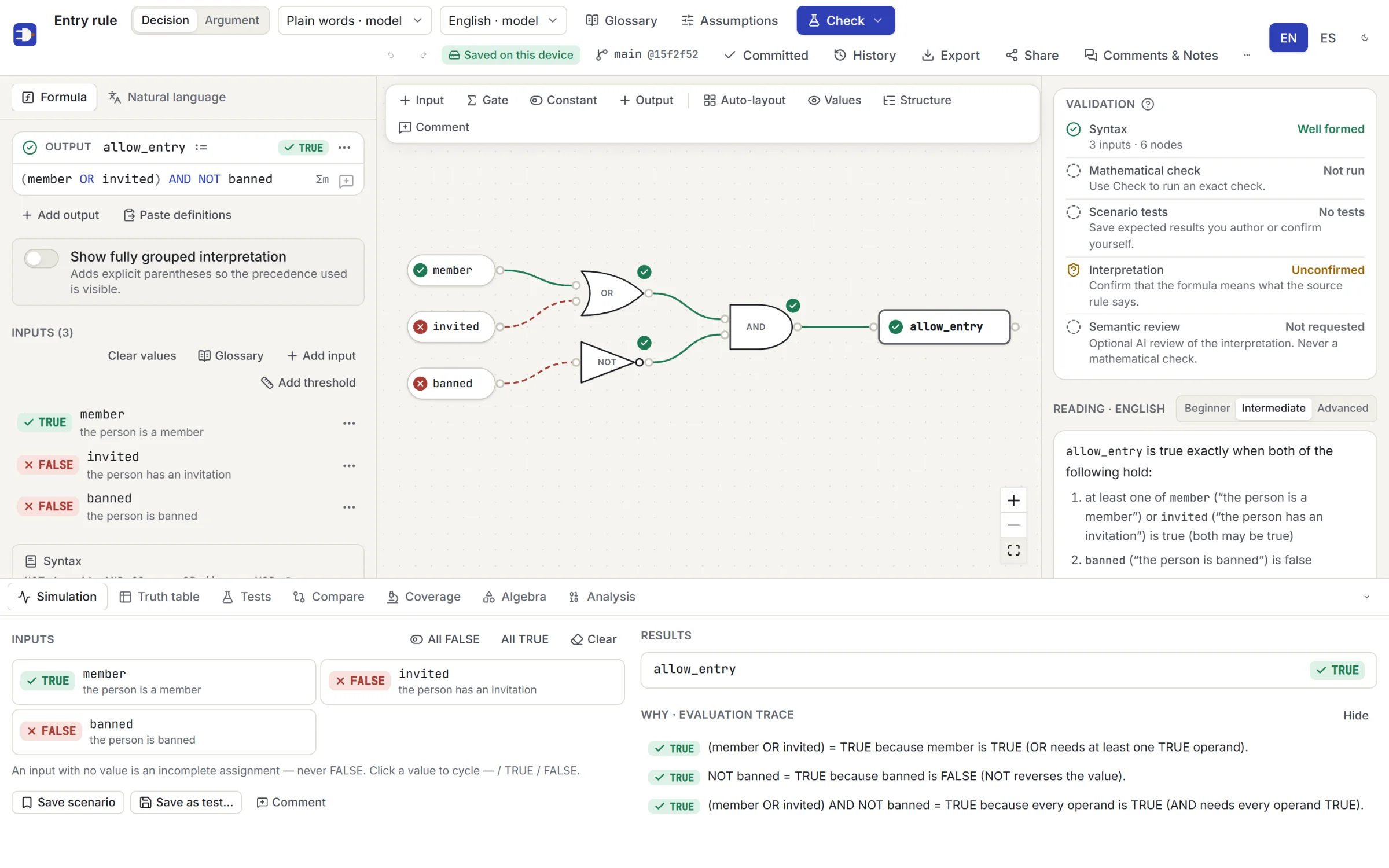
Tangibool is a workspace for drafting, checking, explaining, and testing Boolean logic. Start from plain English, a formula, or a diagram. Then check every case, read it back in plain words, and turn the case that breaks it into a test.
No account needed. It runs in your browser, and your rules stay on your device until you choose the cloud.
Try it here
“Allow entry to members and invited guests, unless they are banned.” Your version and a teammate’s look almost identical. Flip the inputs and see whether you can find where they disagree.
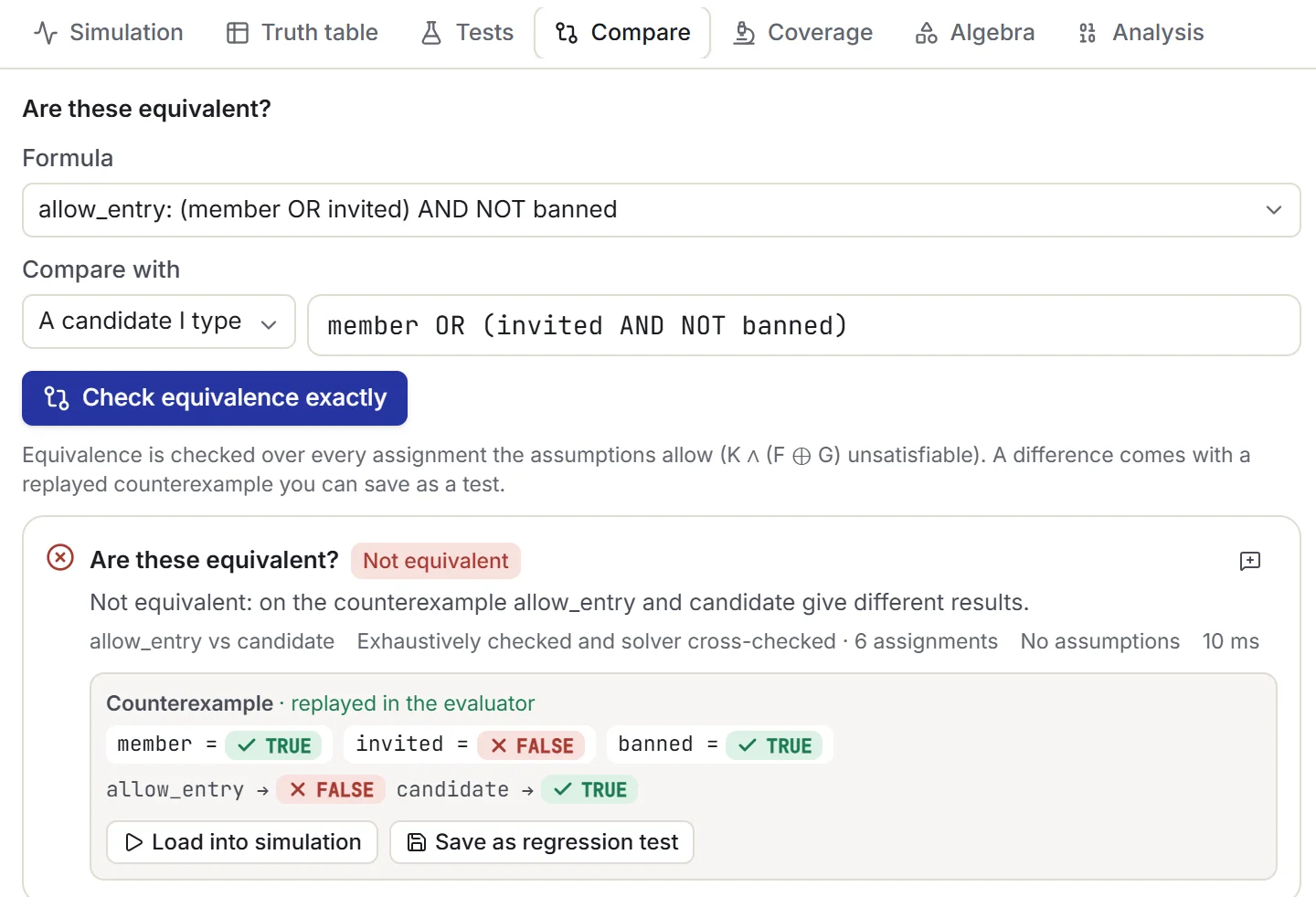
Reading the formula won’t tell you. A diagram alone may not show it, and a plausible explanation isn’t evidence. Tangibool checks all eight cases, shows you the ones that differ, and lets you keep each one as a regression test.
Inputs: select to switch
Results
allow_entry := (member OR invited) AND NOT bannedallow_entry := member OR (invited AND NOT banned)Every case, checked: both versions side by side. They differ in 2 of 8 cases.
| member | invited | banned | Your rule | Teammate’s | Agreement |
|---|---|---|---|---|---|
| FALSE | FALSE | FALSE | FALSE | FALSE | |
| FALSE | FALSE | TRUE | FALSE | FALSE | |
| FALSE | TRUE | FALSE | TRUE | TRUE | |
| FALSE | TRUE | TRUE | FALSE | FALSE | |
| TRUE | FALSE | FALSE | TRUE | TRUE | |
| TRUE | FALSE | TRUE | FALSE | TRUE | Differs |
| TRUE | TRUE | FALSE | TRUE | TRUE | |
| TRUE | TRUE | TRUE | FALSE | TRUE | Differs |
Start your way
Every view edits the same underlying model, so the formula, the diagram, and the plain-English reading always agree with each other.
Describe a rule in English, French, German, or Spanish. AI proposes a formula, a glossary, and open questions, with concrete alternatives when the wording is ambiguous. Nothing is accepted until you confirm it.
Type or paste an expression in programming, mathematical, or textbook notation. Errors are pinpointed with suggested repairs, and your last valid version is never silently lost.
Add inputs and gates, connect ports, and choose an output. Cycles and missing connections are explained rather than accepted, and every editing action also works from the keyboard.
State premises and a conclusion. Tangibool tells you whether it follows, or shows the one assignment where every premise holds and the conclusion fails.
Beyond TRUE and FALSE
Define each one outside the formula. Tangibool compiles it to TRUE/FALSE inputs, derives the facts between them, and keeps every check two-valued and exact.
“Age is at least 18” becomes age_at_least_18, defined as age ≥ 18. Give a number in a scenario and every threshold on that quantity is decided exactly, with the ordering between thresholds derived for you.
Plans, countries, business activities, and ordered scales such as credit ratings or risk classes. Test membership with plan IN Paid or a level with rating ≥ BBB-, and get boundary and class tests proposed for you.
“At least two of three criteria” is one gate, AT_LEAST(2; …), not a chain of XOR. Points tables add up the rows that hold, and score thresholds are inputs your formulas use by name.
Approve, Refer, Decline: define an outcome set as conditions, a rule list, or a decision table, and Tangibool checks that every case gets exactly one outcome, with a replayed case for each gap or overlap.
Honest results
A rule can be well formed and still wrong. It can pass your examples and still mean something you didn’t intend. Tangibool keeps these answers apart, so a green light on one never stands in for another.
When a check runs out of time, it says “Not determined”, never “passed”. Results from an earlier revision are marked stale. A simplification is called “simplified”, not “minimal”.
Is the formula valid, and what exactly does it group together?
Does the property hold for every allowed case? Exact, with a replayed witness.
Does it pass the examples that you, not the formula, said it should?
Does the formula say what the rule means? Only a person can confirm this.
Did an AI reviewer flag an omission or ambiguity? Never a mathematical check.
How AI fits in
Three kinds of evidence, never blended into one score. That’s the rule Tangibool is built around.
Drafting turns your words into a candidate formula, a glossary, and open questions. An optional reviewer looks for omitted exceptions or reversed conditions. Both are proposals, clearly labelled.
A deterministic engine evaluates, checks, and explains. It’s the same engine in your browser, on the server, in the command-line runner, and behind the API, and it never defers to an AI’s confidence.
You confirm what the rule means and write the expectations. Change a word, a glossary meaning, or an assumption, and the confirmation is withdrawn until you look again.
Prefer no AI at all? Leave it off. Every deterministic feature keeps working, and nothing is sent anywhere.
The workspace
Check it, test it, version it, and hand it over, without leaving the workspace or losing track of which revision you checked.
Exact checks
Ask whether two formulas are equivalent, whether a rule can ever be true, whether a conclusion follows, or whether one rule is at least as strict as another. You get a definite answer, or the exact assignment that proves otherwise.
Tests
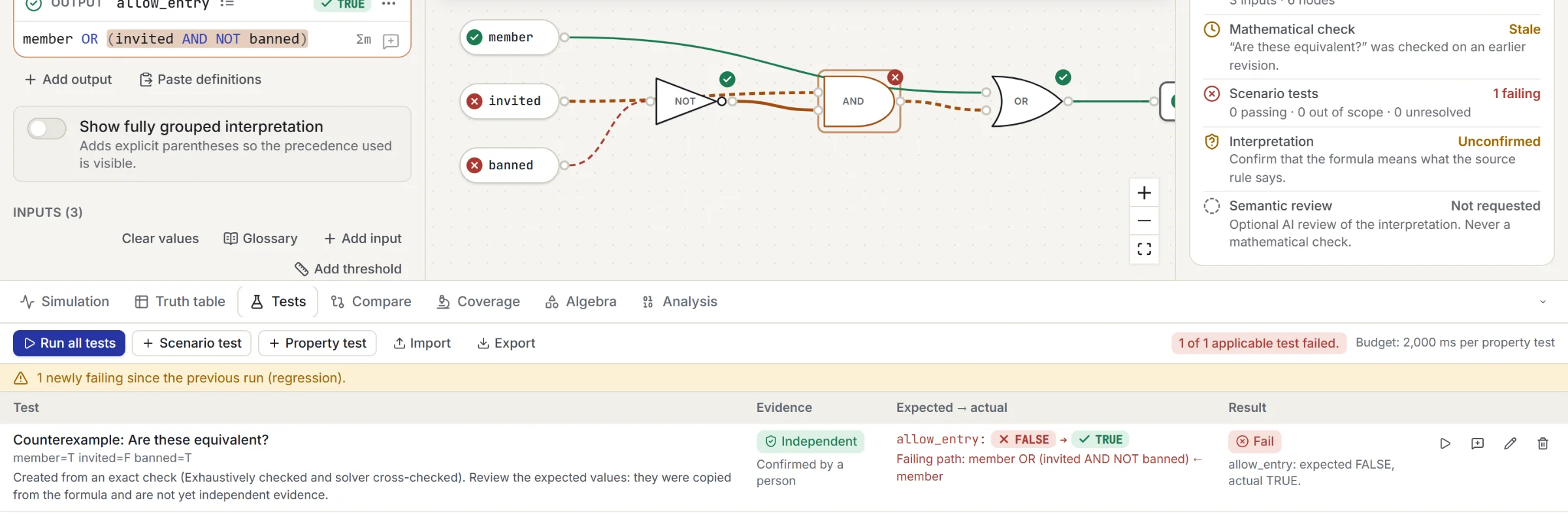
Save the scenarios that matter, along with where each expected result came from. Edit the rule and rerun: a newly failing test is flagged as a regression, and the failing path lights up on the diagram.
Version control
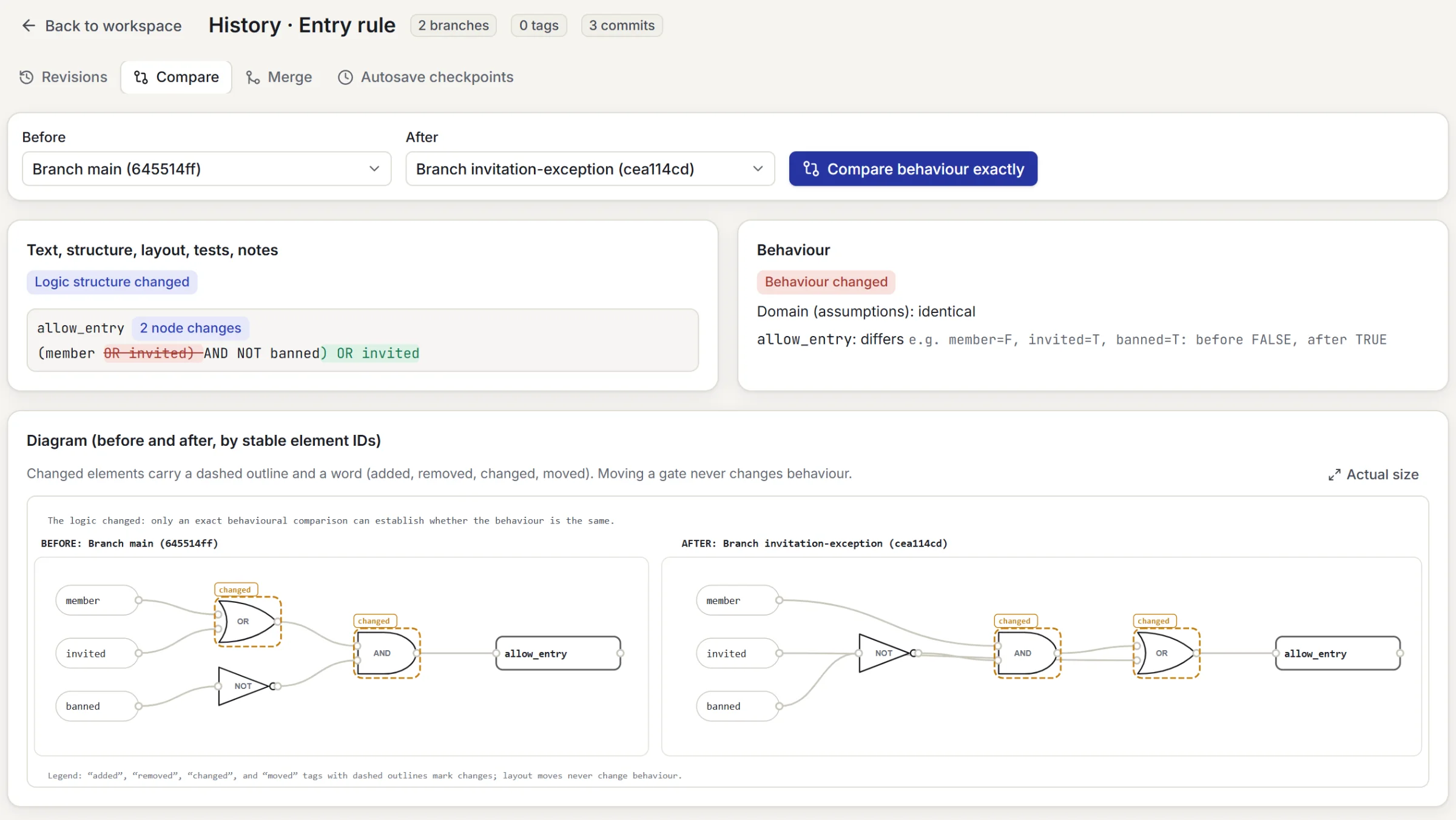
Commit the formula, its source wording, glossary, diagram, and tests together. Branch to try an exception, compare text, structure, layout, and behaviour, then merge with conflicts shown rather than hidden.
Export
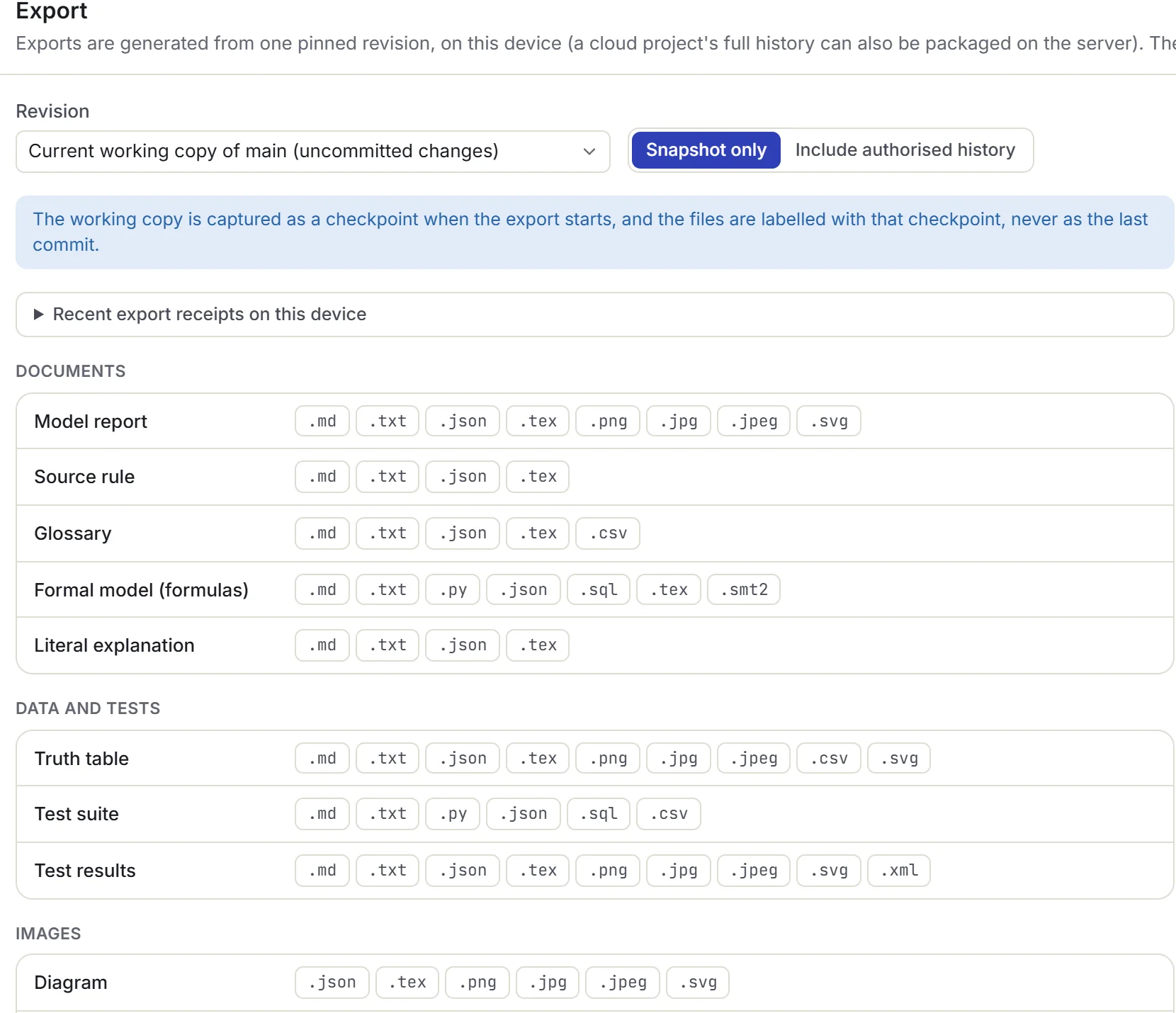
Export one artifact or everything from one pinned revision: Markdown and LaTeX reports, Python and PostgreSQL code, SMT-LIB queries, truth tables, and diagrams as PNG, JPEG, or SVG.
Who it’s for
Refactor a tangled conditional and prove it still does the same thing, or get the input that breaks it. Generate Python, SQL, or SMT-LIB, and run the same tests in CI. Call the same checks from your own code through the API, or from an AI assistant through the MCP server.
Read the developer docsEncode security-level eligibility rules over agency ratings, classifications, and issuer activities as precise logic. Show that an internal rule is at least as strict as the prospectus or the regulation, find the case that slips through, check each rule layer against the one above it, and keep a versioned record of every change for review. Limits computed elsewhere, such as a share of assets, come in as numbers tested against thresholds.
Turn a written eligibility, access, or workflow rule into logic you can read, test, and confirm with stakeholders, while the original wording stays right beside it. Model it over plans, tiers, counts, and scores with several outcomes, and show why a case got its result.
Learn operators, De Morgan’s laws, truth tables, Karnaugh maps, and counting with lessons that open real, checkable models, at beginner, intermediate, or advanced level.
Browse the lessonsPrivacy
Your rules may describe who gets access, credit, or a discount. They deserve care.
Use it signed out. Models, history, notes, and exports stay in your browser until you choose to copy a model to the cloud.
Nothing is sent to an AI provider until you switch that provider on yourself, and then only the text the feature needs.
No product analytics. Our server logs never contain your formulas, notes, prompts, or variable names.
Read the privacy policyPricing
Use Tangibool free in your browser. Paid plans, from $9.99 a month, add cloud models, storage, and AI drafts. Viewers and commenters are always free, and verified students and teachers get 50% off Pro.